Lavender is one of those plants that looks like a holiday in the garden but copes surprisingly badly with being left to its own devices. If you simply let it grow year after year, the branches get longer, the base becomes increasingly bare, and that dense purple cushion eventually turns into a rather straggly shrub. That's partly because lavender isn't botanically a perennial but a sub-shrub: the older parts become woody, while the flowers sit mainly on the fresh new growth. Botanically, plants like this are classed as sub-shrubs; English lavender goes by the name Lavandula angustifolia.
Regular pruning is therefore one of the most important jobs in lavender care. What matters isn't so much exact measurements as three things: the timing, the season, and where the green new growth still sits. If you want to prune the plant correctly, that's exactly what you should look at. In spring you can be bolder. The summer trim after the first flush of flowers is much gentler. Cutting deep into old, bare wood, on the other hand, is a gamble best avoided with this Mediterranean shrub. In this FUXTEC garden guide, we'll show you exactly how to go about pruning lavender.

When should you prune lavender? Spring and summer have different jobs to do
The short answer is: twice a year. The spring prune keeps the plant youthful and in shape, while the summer trim clears away the spent flower stems and can encourage a second flush. That sounds simple, but the two sessions aren't interchangeable.
You'd normally prune lavender in spring between late March and mid-April, once hard frosts are no longer likely and before the strong new growth gets going. In more exposed, colder spots, it's worth watching the weather rather than the calendar. Start too early within this window and you'll only make fresh cuts unnecessarily vulnerable to frost.
The second session follows the main flowering period. As soon as the first flowers clearly start to fade, the time is right – often from late July into August. It's best not to leave the trim until well into late summer, or there won't be much time left for new growth to mature before colder nights return. The general gardening question "when should I prune lavender?" is therefore better answered by looking at the state of the plant than by pinning it to a fixed date.
Pruning lavender in spring: a firm cutback for compact growth
The first prune of the year is all about shape. A plant that's been regularly maintained can be cut back much harder in spring than in August. As a rule of thumb, you can remove up to two-thirds of the green plant volume. What matters more than sticking rigidly to that figure, though, is leaving living, leafy growth behind. The spring cutback needs a bit of judgement rather than a tape measure.
Position your secateurs so that a short section of last year's growth remains. Ideally, you'll leave last year's stems with a few visible sets of leaves in place – shoots with a bit of foliage that the plant can reliably grow on from. Cutting just a few centimetres above the ground would be exactly the wrong approach on an old plant that's already bare at the base.
This approach helps the lavender stay compact and reshoot densely every year, allowing it to stay bushy and branch out well. That's the real purpose of the spring session: not removing as much material as possible, but guiding the new growth habit.
Pruning lavender in summer after flowering: a trim for a possible second flush
Once the lavender has finished flowering, the gentler of the two pruning rounds begins. When you trim lavender in summer, you remove the long flower stems along with some of the fresh green growth. A good guide is to cut the stems back by about a third. This slows down seed formation and encourages the plant to put its energy into new shoots instead.
Especially when trimming lavender in August, though, more is not more. A very hard cutback can mean the new growth doesn't have time to mature before winter. A second flush of flowers in summer also isn't equally generous with every variety, in every region, or in every kind of weather. It's a nice bonus, not a guarantee.
When pruning in summer, leave the leafy base untouched. It's also best to leave very young, fresh side shoots alone. That way the shrub can keep growing densely, without you forcing it into a complete rebuild just before autumn sets in.
Cutting lavender for drying: harvest before it's all gone over
If you want to dry the fragrant stems, don't wait for the same moment as for a straightforward maintenance prune. For dried bunches and lavender bags, it's best to harvest the flower stems while many of the individual flowers are still closed or have only just opened. Fully brown, dried-out flower spikes might look like "better cut these now" in the bed, but by then they're already rather too far gone for a lovely dried bunch.
The best time to harvest is on a dry day, once the dew has gone. Cut the stems cleanly, gather them into loose bunches and hang them upside down somewhere shady and airy. Direct sun speeds up drying but costs the flowers their colour. That way, harvesting doubles up nicely as a light maintenance session too.
Getting the cut right in practice: how far back to prune lavender
Once you're standing in front of the plant, the principle "harder in spring, lighter in summer" is more useful than any measurement in centimetres. First find the zone where leaves and young buds are still present. That's where your cutting line belongs. During the spring session you can remove a large share of last year's growth; in summer the cut stays much lighter. If you just want to shorten a few individual long flower stems, position the blade correspondingly higher up.
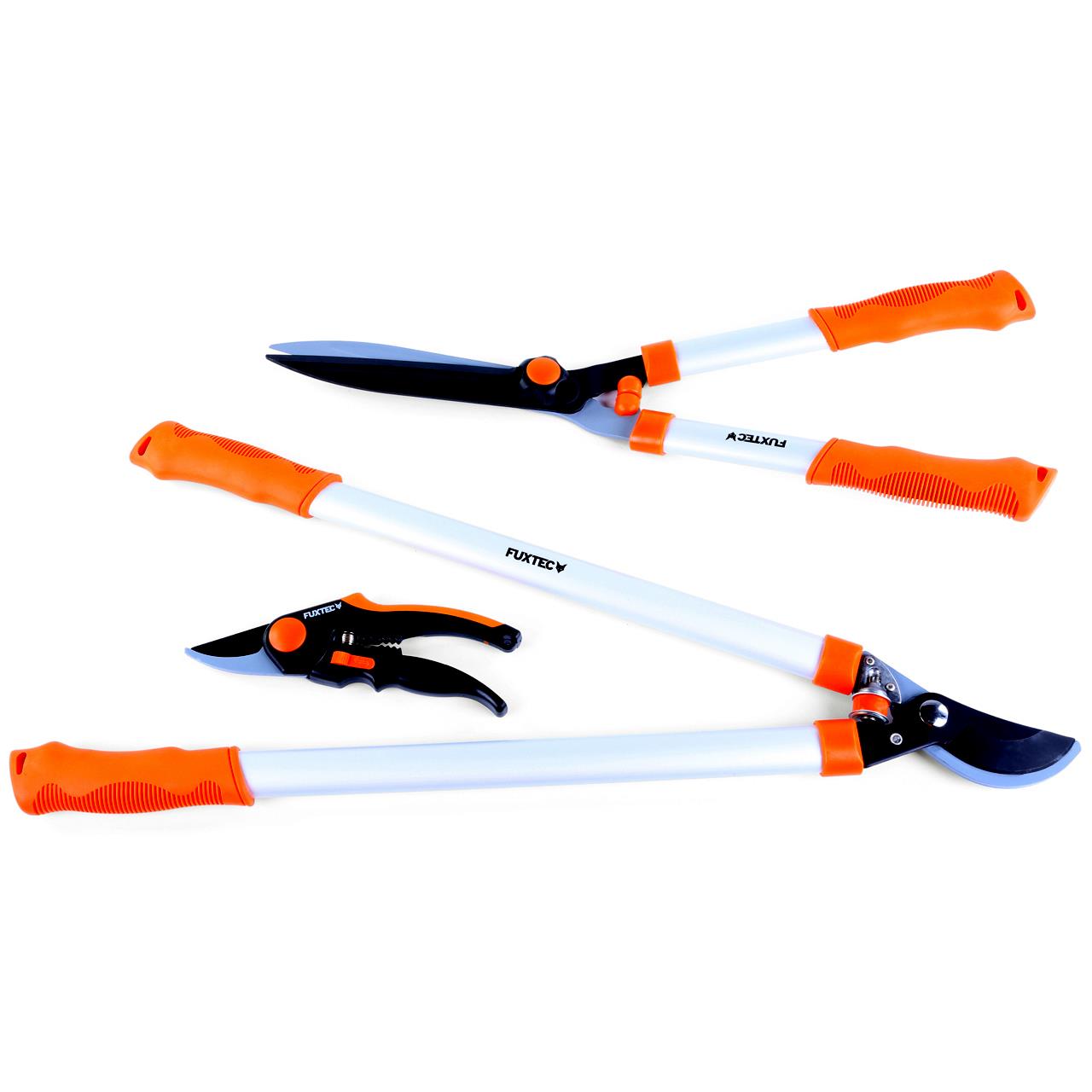
Aim to prune into a slightly rounded shape. That way the outer parts of the plant get light too, and the shrub is less likely to fall apart later on. For a single small plant, sharp secateurs give you maximum control. With several plants, or a low edging, a small shrub shear speeds things up. A long cordless shear really comes into its own when you've got lots of lavender plants growing as a continuous row.
Whichever tool you use, a clean, sharp blade matters. Crushed stems are no mark of quality, even if you can't spot the difference from a couple of metres away afterwards.
Three FUXTEC helpers, from individual plants to a full lavender row
For three individual stems you don't need a cordless tool, and for ten metres of border edging, nobody needs to treat every single stem by hand out of principle either. That's exactly why three tool sizes make sense: precise by hand, handy with a short cordless blade, or quick work over a larger area.
View product: FUXTEC Premium Garden Shears 3-Piece Set FX-SPS3
View product: FUXTEC 20V Grass and Shrub Shears FX-E1HHS20-SET
View product: FUXTEC 20V Cordless Hedge Trimmer FX-E1HS20-SET
Why you shouldn't cut deep into old wood on lavender
The classic mistake usually happens with an older plant: bare at the base, green on top, and generally too big. The understandable instinct is then to cut the woody lavender right back to size. This is exactly where caution is needed. Woody branches with no visible leaf or bud growth often reshoot poorly, if at all.
A radical rejuvenation cut is therefore not a reliable fix for years of neglected pruning. If you do want to cut further into bare old wood, first look for visible green shoots and work in stages. Simply lopping off completely bare, thick sections on the off-chance can leave a gap that never fills back in.
With old plants that have become very bare, it's sometimes more honest to replace them and, with the new plant, commit to regular pruning right from the start. That sounds less dramatic than a rescue mission, but it usually works better in the garden.
Pruning lavender in autumn? Better to leave the shears where they are
Giving your lavender a proper shape-up again in autumn is rarely a good idea. After a late cut, the plant can put on fresh growth that doesn't have time to mature before the first frosts, increasing the risk of winter damage. Spent stems still standing after a missed summer session are therefore fine to leave right through to spring. At that point, you shouldn't cut back hard.
The better rhythm is: prune in spring and in summer, then leave well alone. If you've clearly missed the summer window, there's little to be gained from a late burst of activity. The next sensible pruning session comes in spring, once hard frosts are over.
Pruning lavender in a pot: same principle, just a bit more care needed
The same basic rules apply to container-grown plants as to those in a bed. Because root space and water reserves are limited, though, a potted lavender reacts more quickly to any mistakes in care. Alongside pruning, good drainage matters just as much: waterlogging suits lavender about as well as a boggy peat bed suits Provence.
With a potted specimen, pay particular attention to leaving enough green foliage after pruning. Give it a sunny spot and keep the compost free-draining. A neatly shaped crown is nice to have, but a healthy, vigorous plant matters more.
The most common pruning mistakes – and how to avoid them
Many lavender pruning mistakes aren't down to the wrong tool, but to poor timing. Cutting too late in summer, too deep in spring, or not at all for years – these three habits eventually show up in the plant.
The first common mistake is a lack of consistency. Without regular care, the shrub starts to go bare from the bottom up and can collapse in the middle. The second is the opposite: too much ambition. Cutting deep into completely bare wood risks leaving that area without any new growth at all.
The third mistake is a rigid calendar date. Whether the spring session really suits your garden depends on the weather on your doorstep, not a fixed date. The same applies in late summer: if the main flowering starts fading earlier, the pruning session can happen earlier too. The right window is set by the plant and the weather, not by a neat date in a gardening calendar.
A fourth point concerns expectations of the summer session. A light trim can encourage a second flush of flowers, but it doesn't guarantee one. Variety, position, temperature and previous care all play a part. That's exactly why, when pruning, it's worth focusing not on cutting as short as possible, but on leaving a healthy green remainder behind.
In short: how to keep your lavender looking good
Caring well for your lavender doesn't require a complicated pruning technique. In early spring, shape the plant more firmly, but leave green new growth in place. After the main flowering, a lighter summer session follows. Once that window has passed, the shears wait until the following spring.
This keeps the plant dense, encourages regular fresh growth, and preserves the rounded shape we probably planted it for in the first place. Or put another way: with lavender, the best cut isn't the most drastic one, but the one that leaves enough plant behind to make something beautiful of it.