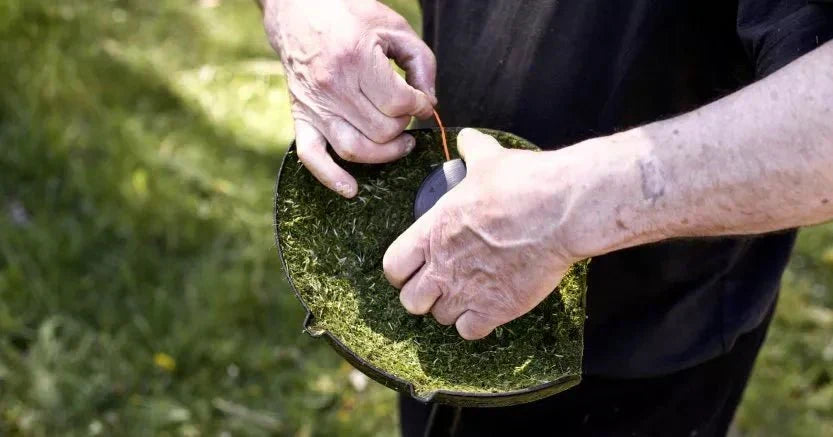
Strimmer Line Guide: Types, Sizes & How to Rewind

Petrol-powered brushcutters cut grass and scrub using a range of different cutting attachments. Alongside a saw blade, mulching blade or scrub blade, the trimmer head is another type of cutting attachment. With it, you can safely mow close to objects without causing much damage – for example along lawn edges, around trees or fence posts. To keep getting good results, however, you'll need to replace the line from time to time.

Why you need to replace your strimmer line regularly

The cutting attachments on a brushcutter are usually interchangeable, so you can pick the right one for each job. However, the longer the line is in use, the more its cutting performance gradually declines. Strimming near stones, house walls or bed edging in particular puts a lot of strain on the line and the engine, which in turn reduces the performance of the brushcutter.

If the strimmer line is badly worn, tangled, or has even snapped, it's time to replace it. A new spool with pre-wound line is convenient, but can get expensive over time. Instead, you can wind new trimmer line onto your existing spool yourself.

TIP: If cutting performance drops off noticeably while you're working, you should retension the line or rewind it if necessary. Once only very short stretches of line are poking out on either side of the spool, it's time for a change.

FUXTEC brushcutters compared

Which brushcutter suits your garden?

Whether you want to neatly tidy up lawn edges, cut back longer grass, or comfortably mow larger areas: here you'll find the right petrol brushcutter for the job.

Light & handy

FUXTEC petrol brushcutter FX-MS125

For lawn edges and general garden work

FUXTEC FX-MS125

The lightweight choice for anyone who wants to tackle grass, weeds and hard-to-reach spots with flexibility.

  • Just 5.5 kg net weight
  • Fuel-efficient 25.4 cc engine
  • Trimmer head and 3-tooth blade included
  • Ergonomic two-handed handle

Push instead of carry

FUXTEC wheeled petrol brush cutter FX-FSR162

For comfortably mowing larger areas

FUXTEC FX-FSR162

The mobile solution on large wheels: ideal if you want to mow powerfully without having to carry the brushcutter the whole time.

  • Powerful 62 cc 2-stroke engine
  • Comfortable guidance on large wheels
  • Professional trimmer head with tap-and-go feed
  • Folds flat for space-saving storage

Own workshop in Germany

Spare parts and accessories available long-term

Order directly from FUXTEC


Round or square: which strimmer line is right?

Depending on the cutting work you're taking on, you can choose from a wide range of different trimmer lines. These differ not only in diameter, but also in shape. Depending on the type of plants you want to cut back, strimmer lines come in the following profiles:

  • Round profile: Round line is the standard type used in brushcutters and winds easily off the spool. However, it's only suitable for soft grass.
  • Square profile: Square-shaped line is suited to tougher cutting jobs, as its sharp edges cut through grass, weeds and scrub.
  • Pentagon or hexagon profile: This line has five or six sides and particularly sharp edges. As a result, it cuts especially well and precisely, making it suitable for many different types of cutting work.
  • Serrated profile: Toothed trimmer line is comparable to a saw blade and is ideal for cutting back scrub and larger plants. However, it should only be used in powerful brushcutters.
  • Spiral profile: So-called twisted, spiral-shaped line stands out for its aerodynamic properties. Air resistance is significantly lower as it spins, making the brushcutter noticeably quieter. Thanks to its spiral edges, this line is especially efficient when mowing. The only downside: it's a bit pricier than other types of strimmer line.

Besides the shape, the diameter of the line is crucial. As a rule of thumb: the tougher the plants, the thicker the line should be. Thinner line, on the other hand, only cuts soft grass, but gives a very clean cut. Depending on your needs, you can choose between the following line thicknesses:

  • 1.4 to 2 mm: Line with a small diameter is suited to lower-powered brushcutters and is ideal for mowing short lawns, light weeds and trimming lawn edges.
  • 2 to 2.7 mm: Strimmer line of this thickness is very versatile and also suitable for taller grass as well as light to denser plant growth.
  • 3 mm: Trimmer line with a thickness of 3 mm is used in brushcutters with medium engine power of around 2 hp and a displacement of roughly 40 cc.
  • 3.3 to 4 mm: Thick line requires a brushcutter with strong engine power and will make light work of tough plants, scrub and undergrowth.

TIP: The thicker the diameter of the strimmer line, the higher the engine power should be. If the engine is too weak, the line will slow down the engine speed and, in the worst case, stall the engine completely. On the other hand, thin line in a powerful brushcutter isn't very effective and uses unnecessarily more fuel.

Soak strimmer line in water before fitting it

Strimmer line is made from a soft, flexible plastic. Over time, however, it loses moisture and flexibility – regardless of whether it's brand new or has been in storage for a while.

For this reason, it's a good idea to soak the line in water for 24 hours before winding it onto the spool. This allows it to absorb water and stay more flexible for longer. You don't need to unwind the line to do this – simply place the whole spool with the trimmer line still on it into the water.

Winding trimmer line onto the spool: step-by-step guide

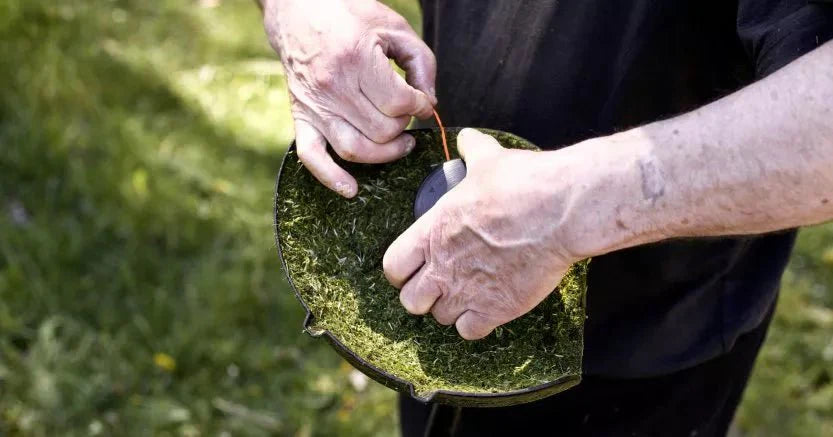
If you haven't opted for a pre-filled spool, you can replace the strimmer line yourself. Generally, you'll need to open up the trimmer head to wind the line onto the spool. Here's how to do it:

  1. First, check whether there's still enough line left on the spool. On brushcutters with a tap-and-go feed, you can release more line simply by tapping the device on the ground. This movement releases the spool's line retention mechanism, feeding out new line. If no new line comes out, the spool is empty.
  2. To wind on new line, first remove the spool cover and take the spool out. If the old line has tangled, snapped, or is badly worn, unwind it completely first.
  3. Thread both ends of the new strimmer line through the two opposite eyelets on the trimmer head and pull them through. To mark the midpoint of the line, hold both ends in one hand and pull the line taut. The middle of the strimmer line forms a loop, which you hook into the notch on the spool.
  4. Next, wrap the line two or three times around the spool so the loop doesn't come loose easily. Then fit the spool into the trimmer head. Make sure to hold the line in place with your thumb so it doesn't unwind again.
  5. With the spool fitted, hold both line ends that stick out of the trimmer head firmly and keep the line taut. Now turn the spool anticlockwise so the line gradually winds on. Always keep the trimmer line pulled tight and under tension as you do this.
  6. Keep winding the line on until both ends are only about 15 cm long. It's important that both ends protrude from the trimmer head by the same length.
  7. Finally, refit the cover onto the spool and you can carry on working with your brushcutter.

Does your brushcutter need an upgrade?

Discover the powerful and versatile FUXTEC brushcutters – perfect for lawn edges, tall grass and dense undergrowth.

What's the difference between round and square strimmer line?

Round line is the standard type that winds easily off the spool but is only suitable for soft grass, whilst square-shaped line has sharp edges that cut through tougher grass, weeds and scrub more effectively.

How often should I replace my strimmer line?

You should replace the line when it becomes badly worn, tangled or snapped, or when cutting performance drops noticeably and only very short stretches protrude from the spool.

What strimmer line thickness do I need?

Thinner line of 1.4 to 2 mm suits soft grass and lawn edges, whilst thicker line of 3 to 4 mm is needed for tougher plants and scrub. As a rule, the tougher the plants, the thicker the line should be, but it must match your brushcutter's engine power.

Should I soak strimmer line before winding it?

Yes, you should soak the line in water for 24 hours before fitting it to help it absorb moisture and remain flexible for longer. You can soak it whilst it's still on the spool without unwinding it.

How do I rewind strimmer line onto my spool?

Thread both ends through the eyelets, hook the midpoint loop into the spool notch, wrap the line around the spool two or three times, fit the spool into the head, then turn it anticlockwise whilst keeping the line taut until both ends are about 15 cm long.

What does a spiral profile strimmer line do?

Spiral-shaped line has aerodynamic properties that reduce air resistance as it spins, making your brushcutter noticeably quieter and more efficient when mowing, though it is slightly more expensive than other types.

Can I use a thicker line in a low-powered brushcutter?

No, thick line in a weak engine will slow down the engine speed and may stall the engine completely. Always match your line thickness to your brushcutter's engine power to avoid performance problems and fuel waste.

Everything for perfect lawn care – clever and powerful with FUXTEC

View all

More brushcutter tips

View all
Brombeeren entfernen: So bekommst Du wilde Brombeeren dauerhaft aus dem Garten

Removing Wild Brambles: Step-by-Step Garden Guide

Wild brambles can turn an overlooked corner of the garden into an almost impenetrable thicket within just a few years. The long, thorny canes creep across beds, fences and paths, take root whereve...

Mähfaden wechseln bei der Motorsense

Strimmer Line Guide: Types, Sizes & How to Rewind

Petrol-powered brushcutters cut grass and scrub using a range of different cutting attachments. Alongside a saw blade, mulching blade or scrub blade, the trimmer head is another type of cutting att...

Motorsense springt nicht an

Motorsense springt nicht an

Die wichtigsten Infos in Kürze wenn der Motor abstirbt, erhält er nicht genügend Treibstoff Vergaser muss richtig eingestellt sein Treibstoffversorgung ist verunreinigt Luftfilter oder Ve...