

Buckeliger Rasen? Nicht mit FUXTEC!
How to Level an Uneven Lawn – Methods & Tips
An uneven lawn can quickly become a real nuisance. You keep catching the mower on bumps, uneven ground creates trip hazards during play, and after every downpour water pools in the nearest hollow. If your lawn is uneven, it's not just the appearance that suffers — lawn maintenance becomes considerably more demanding.
In this FUXTEC garden guide, we show you how to level your lawn effectively. From identifying the cause to choosing the right method for levelling your lawn, you'll find clear, step-by-step guidance here.
Why is your lawn uneven? Identifying the causes of lawn bumps and hollows
Before you level your lawn, it's important to understand where the unevenness comes from. Only then can you prevent the problem from reappearing shortly afterwards.
Settling after laying a new lawn
After laying a new lawn, the soil needs time to settle. If seed is sown too early or the area is used intensively straight away, the surface can later sink and form hollows. Particularly with a freshly new lawn, this can happen quickly if the existing soil was not adequately prepared.
Animals, roots, and other causes of an uneven lawn
Moles and voles loosen the subsoil. First small mounds appear, then the ground collapses. Tree roots also create raised areas, while voids can form underneath. In both cases, typical unevenness develops across your lawn.
Waterlogging and soil compaction in the garden
When drainage is poor, the soil becomes soft. It compacts unevenly or shifts sideways. At the same time, heavy machinery can cause certain areas to become excessively compacted. This leads to uneven lawn growth.
Why you should identify the cause before levelling your lawn
Before levelling your lawn, always check the cause first. If drainage problems exist or animal tunnels run beneath the surface, even the most careful lawn levelling will only be a short-term fix.
Assessing the damage: how uneven is your lawn really?

Not every dip requires a complete overhaul. The right approach depends on the extent of the unevenness.
How to measure height differences across your lawn
Stretch a string line between two wooden pegs and use a spirit level to check it is perfectly horizontal. At the lowest point, measure the distance down to the string. This quickly shows you how severely your overall lawn area is affected.
Identifying minor bumps or a severely uneven lawn
Isolated uneven patches or a shallow depression can usually be corrected locally. With larger areas of unevenness, or where the whole surface looks off-kilter, a more intensive approach is needed.
Calculating how much material you need to level the lawn
Calculate length × width × depth to work out how much topsoil or sharp sand you need. Depending on the situation, soil or sand is used, sometimes as a mix. It's important that there are no large clumps in the material.
When should you level and flatten an uneven lawn?
The best time to level your lawn
The ideal window is mid-April to late May, once the soil has reached at least 10°C. At this point the grass will reliably regrow and any overseeding will take much better.
Why soil moisture and temperature are crucial
Soil that is too wet cannot be worked cleanly — it smears, shifts, and compacts unevenly. If it is too dry, new material will not bond well with the existing lawn.
Levelling a lawn: methods to correct unevenness
If your lawn is uneven, there is no single solution. What matters is how badly the area is affected and where the problem lies. Small dips are treated differently from widespread settling. And this is precisely where "a quick pass over it" differs from a lasting solution.
We walk through the four typical scenarios step by step — explaining what to do, why you're doing it, and what to watch out for.
Rolling the lawn – levelling minor unevenness with a lawn roller
This method is suitable for minor unevenness or slight undulations caused by frost, foot traffic, or minimal settling. Important: we are not talking about deep hollows here, but shallow dips.
Step 1: Preparation
Before you start levelling in earnest, mow the lawn evenly and fairly short. This may sound obvious, but it is essential: only once the grass blades are at a uniform height can you reliably spot small depressions, slight raised areas, or hidden hollows. Sand or soil can also be spread far more cleanly afterwards when there is no long grass in the way.
For this preparation we generally recommend a powerful, cleanly cutting lawn mower from FUXTEC. A consistent cut is the foundation for assessing the lawn accurately — and only with that can you level your lawn with real precision.
Step 2: Rolling
A water-filled lawn roller gently presses the soil downwards. The aim is not to compact the ground heavily, but simply to even out minor height differences.
Important: make several passes in alternating directions across the area. This distributes the pressure more evenly.
A vibrating plate compactor can also be used, but acts considerably more aggressively. It can over-compact the subsoil, which may later impede root growth. For typical garden lawns it is generally overkill.
This method does not work on freshly seeded lawns or where there is more significant unevenness.
Topdressing and filling – correcting shallow hollows precisely
If you have a clear hollow or individual sunken patches, rolling alone is not enough. You need to add material.
Step 1: Prepare the area
Mow the area short and remove any loose clippings. If needed, you can gently lift the turf or loosen it slightly with a spade so that new material can bond with the existing soil.
Step 2: Mix the material
A tried-and-tested mix consists of topsoil and sharp sand in a 1:1 ratio. This ensures good drainage while still retaining sufficient nutrients in the soil.
Depending on the situation, soil or sand alone may be used. Pure sharp sand is more suitable for compaction issues, while topsoil adds more body and substance.
Step 3: Fill the hollows
Spread the material evenly with a rake. The aim is to fill the depression so that the result is a flat, even surface.

If only a thin layer of material is applied, the existing grass will grow through. If a thicker layer of soil is added, you should overseed the area afterwards to prevent any bare patches developing.
It's worth using quality grass seed for overseeding, so the new area blends in visually with the rest of the lawn. Then lightly firm down and water carefully.
Patience is key here. Sometimes two or three passes a few weeks apart is more effective than one drastic measure.
Stripping a severely uneven lawn – when spot repairs are no longer enough
If the entire lawn area is affected or there is significant settlement, filling alone is often no longer sufficient.
Step 1: Remove the turf
Use a spade to cut and lift the turf. This may sound drastic, but it is sometimes necessary when the subsoil is unstable or has been undermined by moles or voles.
Step 2: Reshape the subsoil
Now you can redistribute the soil. Make sure you create smooth, even transitions. Use a string line and spirit level to check the surface is flat.
Step 3: Fine-tuning
Once you have rebuilt the surface, remove any excess soil and smooth out any smaller transitions.
This approach comes close to a complete re-lay. You should therefore be sure beforehand that the extent of the unevenness genuinely justifies a major intervention.
Digging over and re-laying the lawn – the complete solution
When the subsoil is unstable or the ground was poorly prepared in the first place, a complete restart is the only option.
Step 1: Thoroughly break up the soil
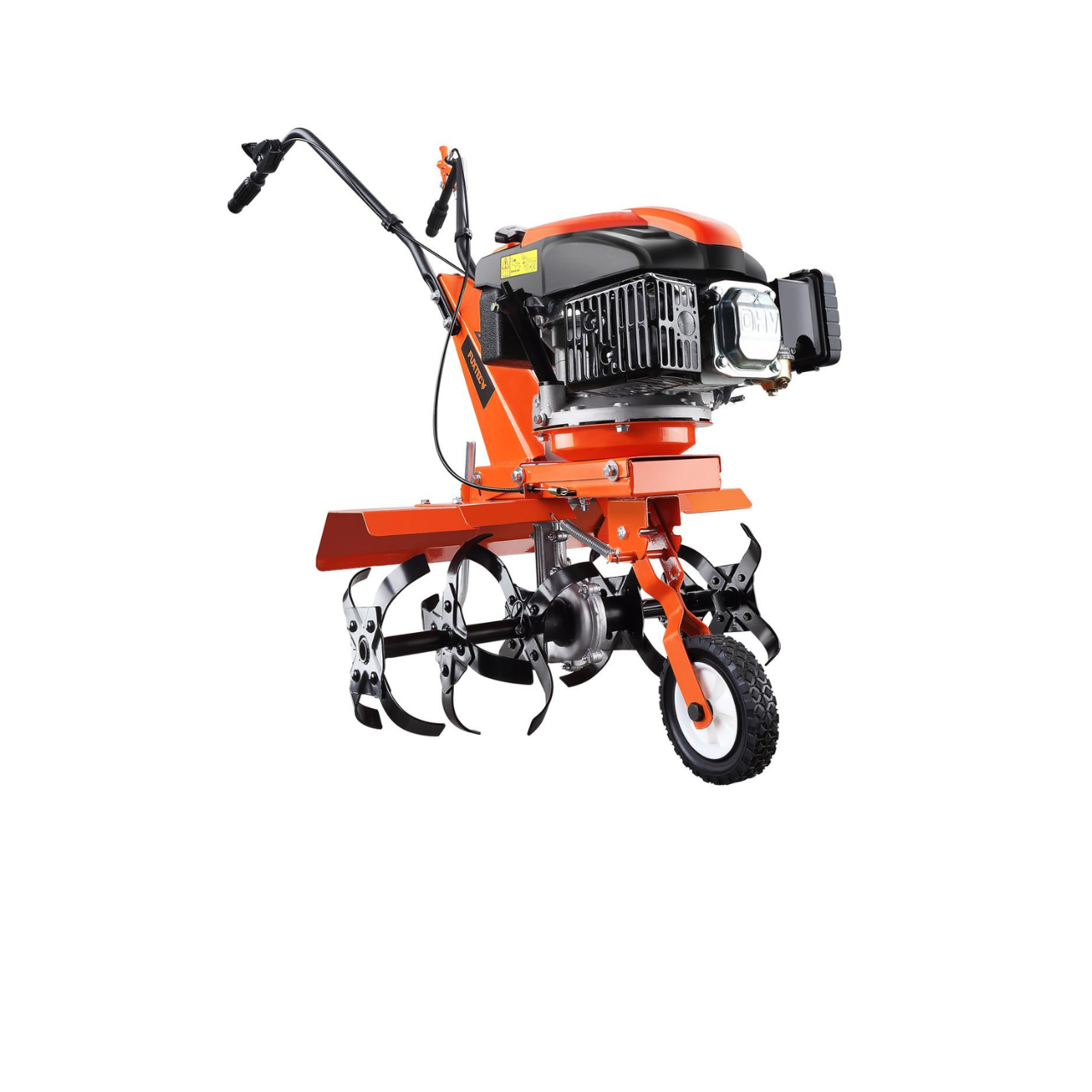
With a rotavator from FUXTEC you can work the soil to a good depth. This is particularly worthwhile when the soil is heavily compacted or old layers need to be broken up.
Find out how to get your soil properly loosened in the FUXTEC garden guide "Soil Improvement: Tips for Loose and Healthy Soil".
Step 2: Re-shape the surface
Rake the area level, even out height differences, and create a gentle slope so that water can drain away afterwards.
Step 3: Preparation for sowing
Before sowing, lightly roll the area so the soil can settle. Then re-seed. At this point you are essentially carrying out a new lawn installation.
If everything has been done correctly, the lawn will establish evenly. Once the grass is growing well in the first few weeks, a dense, lush carpet will develop.
Why taking care here really pays off
An uneven lawn can quickly become an ongoing headache. If only superficial work is done, the surface will sink again and form hollows. Those who take a structured approach, however, create the foundation for a permanently stable base.
After levelling, regular lawn care is essential. It can be well worth scarifying the lawn — for example with the
FUXTEC Petrol Scarifier FX-VT150
— to remove thatch and ensure the lawn receives sufficient oxygen and every important nutrient.
Aftercare for a permanently level lawn in your garden
After levelling your lawn, ongoing care is key. Mow regularly to encourage even growth. When needed, it is worth scarifying with a FUXTEC scarifier. This prevents thatch build-up and ensures every nutrient is absorbed more effectively.
If the subsoil remains stable in the long term, your well-maintained lawn will also stay visually level. That way, your lawn stays reliably resilient over time.
Conclusion: When is it worth levelling an uneven lawn for good?
An uneven lawn doesn't just look untidy — it affects how you use and maintain it. If you take a systematic approach and choose the right method for the damage at hand, you can level your lawn effectively.
Whether a minor correction or a complete re-lay of the lawn — with the right tools, patience, and a well-thought-out approach, the grass will grow back evenly. And in the end, you'll have exactly what every garden owner hopes for: a thick, resilient, and uniformly green carpet in your own garden.
Entdecke unsere Auswahl an Gartengeräten



What causes an uneven lawn and how can I prevent it?
Uneven lawns are typically caused by settling after laying new turf, animal tunnelling from moles and voles, tree roots creating raised areas, or poor drainage leading to soil compaction. To prevent recurrence, identify the root cause before levelling—if drainage problems or underground tunnels exist, levelling alone will only be a temporary fix.
How do I measure how uneven my lawn actually is?
Stretch a string line between two wooden pegs and use a spirit level to check it is perfectly horizontal. At the lowest point, measure the distance down to the string to determine the severity of unevenness. This quick method shows you whether isolated patches can be corrected locally or if a more intensive approach is needed.
When is the best time to level my lawn?
The ideal window is mid-April to late May, once the soil has reached at least 10°C. At this temperature, grass will reliably regrow and any overseeding will take much better. Soil moisture is also crucial—avoid working with soil that is too wet or too dry, as both prevent proper bonding and even settling.
What's the difference between rolling and topdressing a lawn?
Rolling with a water-filled lawn roller is suitable only for minor unevenness caused by frost or foot traffic. Topdressing involves adding a 1:1 mix of topsoil and sharp sand to fill shallow hollows and depressions. Rolling alone cannot fix clear hollows, which require material to be added and levelled with a rake.
Do I need to overseed after topdressing my lawn?
If you apply only a thin layer of material, existing grass will grow through. However, if a thicker layer is added, you should overseed the area afterwards to prevent bare patches developing. Using quality grass seed ensures the new area blends in visually with the rest of the lawn.
When should I strip and re-lay my entire lawn?
Complete re-laying is necessary when the entire lawn area is severely affected, the subsoil is unstable, or the ground has been undermined by animals. This drastic approach involves removing turf, reshaping the subsoil with a spirit level to ensure flatness, and then re-seeding as if installing a new lawn.
What ongoing care keeps a levelled lawn permanently even?
Regular mowing encourages even growth, and scarifying removes thatch build-up whilst ensuring nutrients are absorbed effectively. If the subsoil remains stable through good maintenance practices, your lawn will stay visually level and resilient over time.
Alles, was dein Rasen braucht



Weitere Beiträge zum Thema Rasenpflege

Mulchen mit Pinienrinde: So nutzt du organischen Mulch, um Unkraut zu verhindern
Das Mulchen mit Pinienrinde gehört zu den effektivsten Methoden im modernen Gartenbau und in der nachhaltigen Landwirtschaft. Dabei wird eine Schicht Mulchmaterial auf die Bodenoberfläche aufgebrac...
Bodenverbesserung im Garten: So verbesserst du deinen Gartenboden im Frühjahr für gesunde Pflanzen
Inhaltsverzeichnis Warum Bodenverbesserung im Garten im Frühjahr so wichtig für einen gesunden Gartenboden ist Gartenboden nach dem Winter prüfen: Bodenstruktur, Verdichtung und Bodenart erke...

Richtig Düngen im Garten: Schritt für Schritt erklärt
Inhaltsverzeichnis Warum Düngen im Garten so wichtig ist Bodenanalyse: Grundlage für die richtige Düngung Organische vs. mineralische Dünger: Was ist besser? Kompost, Hornspäne & Co.: Organi...


