

FUXTEC hilft Mehltau in deinem Garten zu bekämpfen!
Mildew in the Garden: Identify & Treat It
Inhaltsverzeichnis
- Was ist Mehltau? – Mehltau erkennen, Pilzkrankheiten und Unterschiede im Garten
- Echter und falscher Mehltau erkennen: Symptome und Befall bei Pflanzen und Rosen
- Ursachen für Mehltau im Garten: Warum Pflanzen anfällig sind
- Mehltau bekämpfen: Bekämpfung von Mehltau und vorbeugen im Garten
- Mehltau bekämpfen mit Hausmitteln: Einfache Hausmittel gegen Mehltau
- Mehltau vorbeugen: Vorbeugung und resistente Pflanzen im Garten
- Praxisbeispiele: Echter und falscher Mehltau im Vergleich und Bekämpfung
- Fazit: Mehltau erkennen und bekämpfen für gesunde Pflanzen
Mildew is one of the most common fungal diseases in the garden, and hardly any plant is entirely safe from it. Whether in a greenhouse or outdoors, mildew appears regularly and can seriously weaken both edible and ornamental plants. Powdery mildew in particular is easy to spot, as it produces a white, powdery coating that spreads rapidly across leaf surfaces. But it's not just roses and cucumbers that are susceptible — many other plants can be affected too, and a severe outbreak can be very difficult to get under control.
Anyone wanting to tackle mildew naturally or prevent it from taking hold should understand the key differences between powdery mildew and downy mildew. In this article, we'll show you how to identify mildew, how to respond quickly when it appears, and how to successfully treat both powdery and downy mildew — for healthy plants, strong harvests, and a thriving garden year.
What Is Mildew? – Identifying Mildew, Fungal Diseases and Differences in the Garden
Mildew is an umbrella term for various fungal diseases that can affect numerous garden plants — from roses and ornamentals to grapevines and vegetables. The most distinctive sign is the typical white or grey coating that spreads across the upper surface of leaves and, less commonly, on shoots. There are two main types: powdery mildew and downy mildew. Both have their own pathogens, occur under different conditions, and require different treatment approaches.

Powdery mildew is often called a "fair-weather fungus" because it thrives particularly in warm, dry conditions. Downy mildew, by contrast, prefers cool, damp weather and is frequently seen after rainy spells. Mildew is one of the most prevalent fungal diseases in the garden and can affect both edible crops and ornamental plants such as roses and perennials. The spores of mildew fungi typically overwinter on fallen leaves or plant debris, causing fresh infections the following year.
Identifying Powdery and Downy Mildew: Symptoms and Infection in Plants and Roses
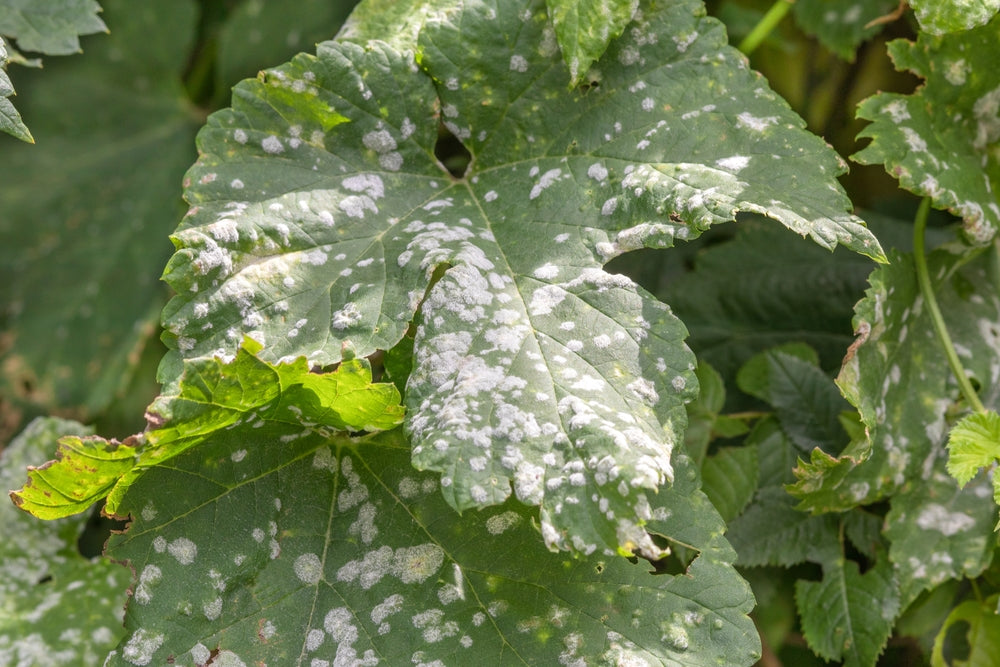
Powdery mildew appears as a wipeable, white, flour-like coating found mainly on the upper surface of leaves and on young shoots. It spreads via spores that are easily carried by the wind. Over time, the fungus damages plant tissue — leaves curl, turn yellow, and eventually die off. Infection with powdery mildew is a common problem on roses and grapevines alike. Severely infected plant parts should be removed and disposed of in household waste (not the compost bin) to prevent further spread.
Downy mildew is harder to identify. The growth typically appears on the underside of leaves as a grey, fluffy fungal coating, while the upper surface shows yellow to brown patches. Downy mildew is a fungus that thrives particularly during wet periods. Affected leaves wilt and die off prematurely. Downy mildew can also appear on stems, flowers, and other parts of the plant. A characteristic sign is the rapid dieback of affected areas, which can seriously impair both yield and plant growth.
Causes of Mildew in the Garden: Why Plants Are Susceptible
The main causes of mildew are unsuitable growing conditions, poor air circulation, overcrowded planting, and either humid or very dry weather. Powdery mildew thrives when plants are growing in stuffy, warm air with little air movement. The spores of powdery mildew spread from infected plant parts, fallen leaves, or garden compost, and go on to infect new plants in spring.
Plants that are frequently affected by mildew are often weakened by fluctuating temperatures, lack of water, or nutrient-poor soil. Choosing unsuitable plant varieties also increases the risk of susceptibility to mildew. In contrast to powdery mildew, downy mildew is encouraged by prolonged moisture and high humidity — for example after heavy rainfall or persistent dew on leaves.
Treating Mildew: How to Combat Mildew and Prevent It in the Garden
To treat mildew effectively, you need to distinguish between powdery and downy mildew. If you're dealing with powdery mildew, remove infected plant parts immediately and dispose of them in your general household waste — not the compost — as spores can otherwise spread further. In cases of severe infection, a targeted cutback of affected parts may be the only option. Fungicides can be used, but should ideally be a last resort and always applied according to the manufacturer's instructions.
To prevent fungal infection in the long term, it's important to plant with adequate spacing, ensure regular ventilation, and maintain a balanced nutrient supply. Downy mildew is best tackled by avoiding persistent wet foliage and ensuring good air circulation. Water in the morning where possible, directing water at the roots to keep leaves dry. Choosing disease-resistant or mildew-tolerant varieties is a great way to reduce the risk. When feeding plants, avoid over-applying nitrogen, as this encourages the growth of soft, vulnerable plant tissue that is more easily attacked by fungi.
Mildew on Roses: How to Identify and Treat Rose Mildew
Roses are among the most popular yet most mildew-prone ornamental plants. Powdery mildew appears as a white, flour-like coating on leaves, young shoots, and buds. Mildew on roses can spread rapidly and, in the worst cases, leads to the dieback of entire shoots. The spores of powdery mildew overwinter on old leaves and become active again in spring.
To treat mildew on roses, remove all infected leaves and shoots generously and dispose of them in your general household waste. Ensure an airy planting position, avoid overhead watering, and feed sparingly. At the first sign of a white coating, it is worth applying preventative home remedies such as a bicarbonate of soda solution, or spraying with a specialist fungicide for ornamental plants. Regularly removing fallen leaves and pruning out congested growth helps limit the spread.
Mildew on Cucumbers and Courgettes: Identifying and Treating Powdery and Downy Mildew
Cucumbers and courgettes are particularly often affected by powdery or downy mildew. Powdery mildew again appears as a white, wipeable coating on the upper surface of leaves. An infected plant struggles to grow, fruits ripen more slowly, and may show distortion. Downy mildew produces a grey fungal coating on the underside of leaves, while yellow to brown patches appear on the upper surface. In greenhouses, high humidity encourages the rapid spread of fungal spores.
For both types: remove infected leaves immediately, ensure good air circulation, and consider switching to resistant varieties. In cases of severe infection, the use of fungicides may be necessary — always check the guidance for edible crops! When caring for cucumbers, courgettes, or grapevines, a loose, nutrient-rich soil is important. Waterlogging must be avoided at all costs to keep plants resilient against fungal diseases.
Treating Mildew with Home Remedies: Simple DIY Solutions Against Mildew
There are several tried-and-tested home remedies for combating mildew naturally. One of the best-known methods is a solution of bicarbonate of soda and water (1 tsp bicarbonate of soda to 1 litre of water), sprayed onto the affected plant parts. This alters the pH on the plant's surface, making conditions less favourable for the fungus. A mixture of fresh milk and water (ratio 1:9) has also proven effective for mild infections. These home remedies are most suitable for treating powdery mildew.

Home remedies are generally less effective against downy mildew, because the fungus develops within the plant tissue. Here, the priority is removing and disposing of infected plant parts — burning where permitted by local rules. In cases of severe infection, a specialist fungicide should be used. It's also important to disinfect all tools after cutting, to avoid transferring spores.
Preventing Mildew: Prevention and Mildew-Resistant Plants in the Garden
Prevention is key when it comes to mildew. Choose varieties that are known to be resistant or tolerant to mildew fungi, and opt for a sunny, airy position with sufficient space between plants. Good cultivation practices — regularly removing fallen leaves, avoiding overhead watering, and watering at the base in the morning — all help prevent mildew from taking hold. Avoid over-feeding with nitrogen; instead, aim for a balanced nutrient supply.
Thinning out overcrowded plantings improves air circulation and deprives the fungus of the conditions it needs to survive. Mulching with compost helps keep the soil healthy, boosting plants' resistance to fungal diseases such as mildew. Always make sure that infected leaves are disposed of and not added to the compost heap.
Practical Examples: Powdery vs Downy Mildew – Comparison and Treatment
A direct comparison shows that powdery mildew typically appears as a white, flour-like coating on the upper surface of leaves, while downy mildew manifests as patches and a fuzzy fungal growth on the underside. Both types can affect a wide range of plants and spread quickly under favourable conditions. In viticulture, infection with powdery mildew ("oidium") and downy mildew ("peronospora") represents one of the most significant fungal threats, capable of causing serious crop losses.
The best results in controlling both powdery and downy mildew come from combining preventative measures, promptly removing infected plant parts, and — in severe cases — using fungicides. In gardens that are regularly monitored and well maintained, fungal spores can be spotted early and plant dieback can be prevented.
Conclusion: Identifying and Treating Mildew for Healthy Plants
Mildew is one of the most common fungal diseases in the garden. Whether it's powdery or downy mildew, spotting symptoms early, keeping up with regular care, and taking preventative action will protect your plants from severe infection. Check both the upper and lower surfaces of leaves regularly, remove infected leaves at the first signs, and use tried-and-tested home remedies such as bicarbonate of soda solution when needed. Mildew-resistant plants, good growing conditions, and targeted prevention and treatment measures all ensure that mildew never gets the upper hand in your garden — keeping ornamental plants, roses, grapevines, and vegetables healthy so you can enjoy a colourful, vibrant, disease-free garden.
Everything for your garden

What's the difference between powdery mildew and downy mildew?
Powdery mildew appears as a white, flour-like coating on the upper surface of leaves and thrives in warm, dry conditions, whilst downy mildew shows as a grey, fuzzy growth on the underside of leaves and prefers cool, damp weather. Powdery mildew spreads via airborne spores, whereas downy mildew develops within plant tissue and is harder to treat with home remedies.
How do I treat mildew on my roses?
Remove infected leaves and shoots immediately and dispose of them in household waste rather than compost. Ensure your roses have an airy position, avoid overhead watering, and at the first sign of white coating, apply a bicarbonate of soda solution or a specialist fungicide designed for ornamental plants.
Can I use home remedies to get rid of mildew?
Yes, a bicarbonate of soda solution (1 tsp per litre of water) or a milk and water mixture (1:9 ratio) are effective home remedies, particularly for powdery mildew, as they alter the pH on the plant's surface. However, home remedies are less effective against downy mildew, which may require specialist fungicides in severe cases.
Why do my plants keep getting mildew?
Mildew thrives in unsuitable growing conditions such as poor air circulation, overcrowded planting, and either very dry or very wet weather depending on the type. Weakened plants — those suffering from fluctuating temperatures, lack of water, or nutrient-poor soil — are particularly susceptible to fungal infection.
How can I prevent mildew in my garden?
Choose mildew-resistant varieties, plant with adequate spacing, ensure good air circulation, water at the base in the morning to keep leaves dry, and remove fallen leaves regularly. Avoid over-feeding with nitrogen and thin out overcrowded plantings to improve air flow and reduce conditions favourable to the fungus.
Are cucumbers and courgettes prone to mildew?
Yes, cucumbers and courgettes are particularly susceptible to both powdery and downy mildew, especially in greenhouses where high humidity encourages rapid spread of fungal spores. Remove infected leaves immediately, ensure good ventilation, and consider switching to resistant varieties to reduce the risk of severe infection.
Should I put infected plant leaves in my compost bin?
No, you should always dispose of infected leaves and plant parts in your general household waste, not in the compost bin, as the fungal spores can otherwise spread further and contaminate your compost.
More articles about garden care
Mulchen mit Pinienrinde: So nutzt du organischen Mulch, um Unkraut zu verhindern
Das Mulchen mit Pinienrinde gehört zu den effektivsten Methoden im modernen Gartenbau und in der nachhaltigen Landwirtschaft. Dabei wird eine Schicht Mulchmaterial auf die Bodenoberfläche aufgebrac...
Bodenverbesserung im Garten: So verbesserst du deinen Gartenboden im Frühjahr für gesunde Pflanzen
Inhaltsverzeichnis Warum Bodenverbesserung im Garten im Frühjahr so wichtig für einen gesunden Gartenboden ist Gartenboden nach dem Winter prüfen: Bodenstruktur, Verdichtung und Bodenart erke...
Richtig Düngen im Garten: Schritt für Schritt erklärt
Inhaltsverzeichnis Warum Düngen im Garten so wichtig ist Bodenanalyse: Grundlage für die richtige Düngung Organische vs. mineralische Dünger: Was ist besser? Kompost, Hornspäne & Co.: Organi...


